The full story
What it means for you
- Only 500 standard and 100 Tricolore bikes are planned, and no price is given: if you want one, contact a Ducati dealer now about allocation and cost.
- North American buyers should expect delivery from Q1 2027, with the limited-edition jacket and helmet included.
- The 247 hp figure, the 368 lb track weight and several kit parts depend on components Ducati marks as not road-approved; ride on the street in the 228 hp Euro 5+ setup.
- Carbon-ceramic discs need their own dedicated pads; ask the dealer about pad supply and service before your first track day.
- The MotoGP Experience is limited to 26 owners on July 6-7 and costs extra; ask how places are allocated.
- Use the supplied battery charger, cover and stands for storage, and keep the crate, certificate and signed valve-timing plate, which document a numbered bike.
What changed for 2027
Superleggera V4 Centenario
- Updated
Engine displacement
998 cc (Desmosedici Stradale R)1,103 cc
- Updated
Stroke
48.41 mm53.5 mm
- Updated
Throttle bodies
52 mm (Desmosedici Stradale)56 mm oval
- New
Brakes
Brembo Hyction 340 mm carbon-ceramic discs, GP4-HY calipers
- New
Suspension
Öhlins NPX 25/30 Carbon pressurized fork
- New
Electronics
DVO strategies; Engine Brake Control DVO with Dynamic Engine Brake
- Color only
Colors
GP26 Rosso Centenario; Tricolore (100 units)
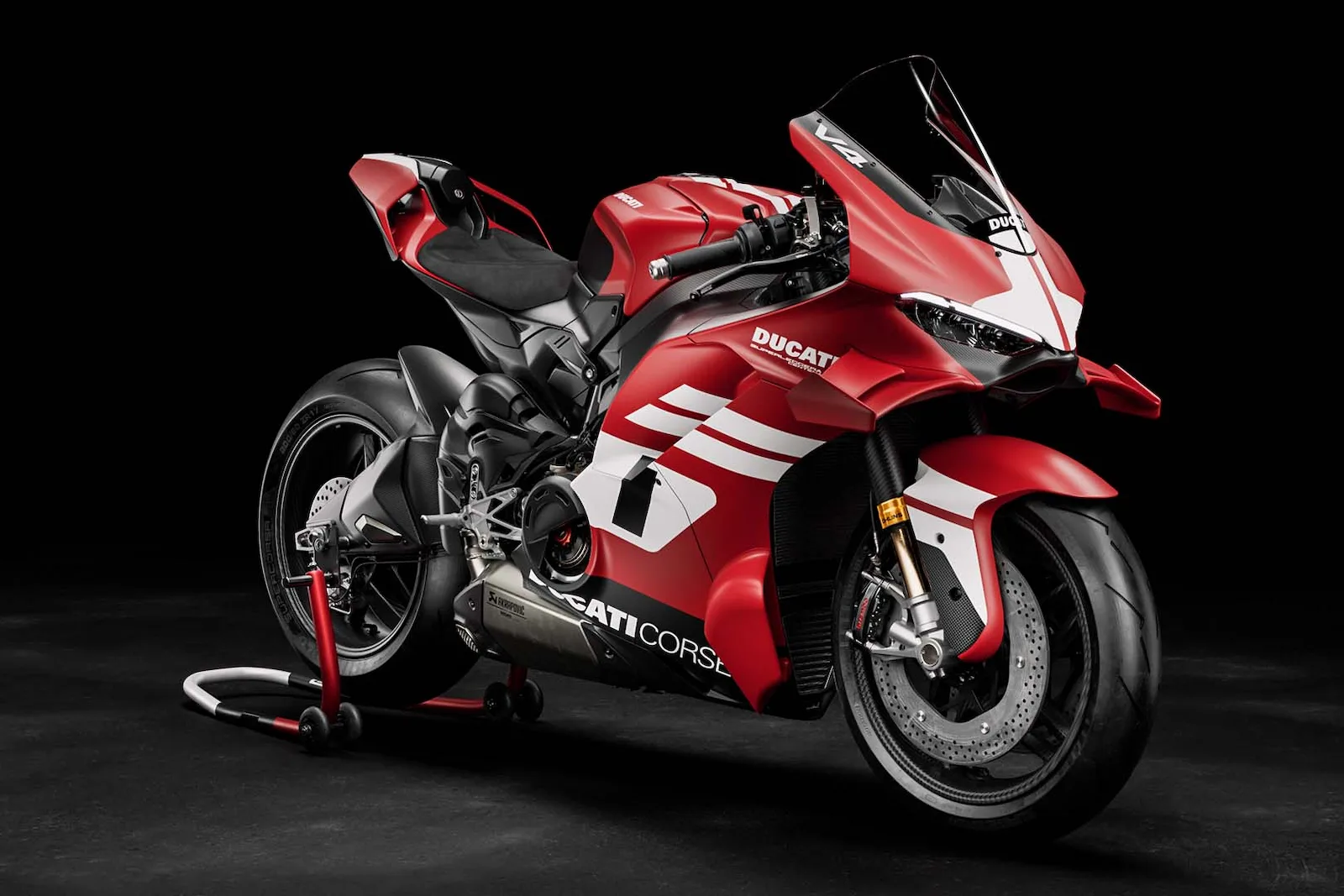
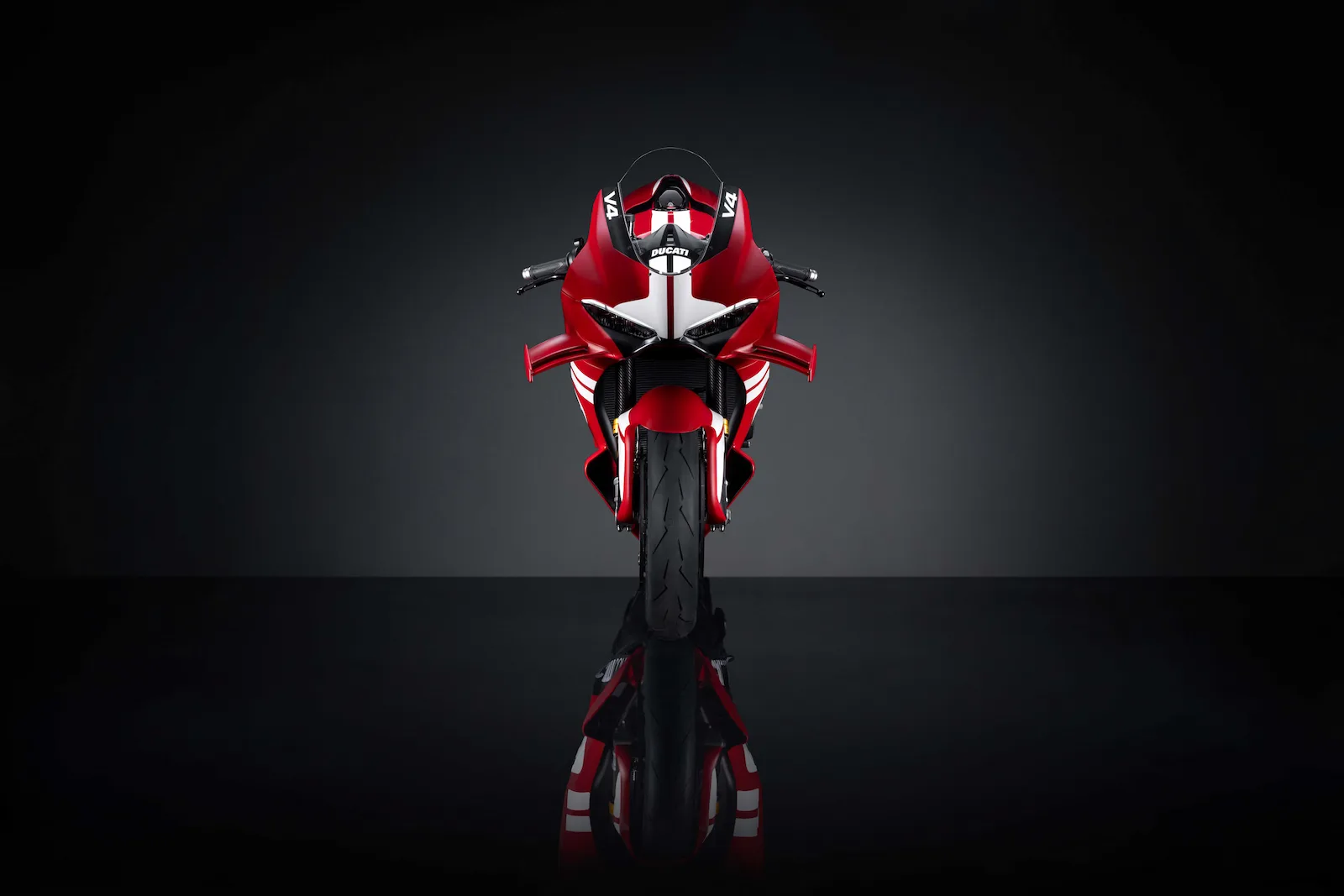
Ducati's centenary bike is the Superleggera V4 Centenario, which the company calls the most extreme road-legal motorcycle it has ever made. It is a limited series of 500 numbered bikes, joined by 100 more in a Tricolore livery. Built on the seventh generation of Ducati's Superbike, it has a chassis made entirely of carbon fiber, a new engine called the Desmosedici Stradale R 1100, and two hardware firsts for a road-legal bike: Brembo carbon-ceramic brake discs and a pressurized Öhlins fork with carbon-fiber sleeves.
The headline figures are 228 hp in road trim, quoted for the Euro 5+ configuration, and 247 hp with the supplied Akrapovič racing exhaust. Wet weight without fuel is 381 lb, or 368 lb in track form; Ducati quotes a power-to-weight ratio of .67 hp/lb. Every bike ships in a wooden crate with a full track kit. North American deliveries begin in Q1 2027. The release does not give a price.
This is a collector's motorcycle first, but the parts list is aimed at riders who will use it on a circuit. The sections below cover what each change does.
The Superleggera line and the Centenario's place in it
Ducati says its Superleggera models happen when engineers work without the usual cost and production limits, and each one has brought something new to a production bike. The 2013 1199 Superleggera used a magnesium-alloy frame, swingarm and wheels. The 2016 1299 Superleggera was the first motorcycle with a carbon-fiber chassis. The 2020 Panigale V4 Superleggera pushed aerodynamics further. The Centenario adds carbon-ceramic brakes, a carbon-sleeved fork and a larger engine to that list.
Superleggera V4 Centenario Tricolore
Alongside the 500 standard bikes, Ducati is building 100 Superleggera V4 Centenario Tricolore models. Their paint looks back to the 750 F1 Endurance Racing, which Ducati describes as its last classic two-valve racer and one of its rarest bikes of the 1980s. The Tricolore colors are redrawn in a modern design. The release gives no separate specifications or price for the Tricolore, so confirm its equipment with Ducati.
MotoGP Experience
Twenty-six owners will get a place at the MotoGP Experience: a track day with Ducati instructors on their Superleggera that ends with a ride on the DesmosediciGP26. It runs on July 6-7, right after World Ducati Week 2026. A footnote makes clear the experience is not part of the bike's price, and the release does not say how the 26 owners are chosen.
Brakes
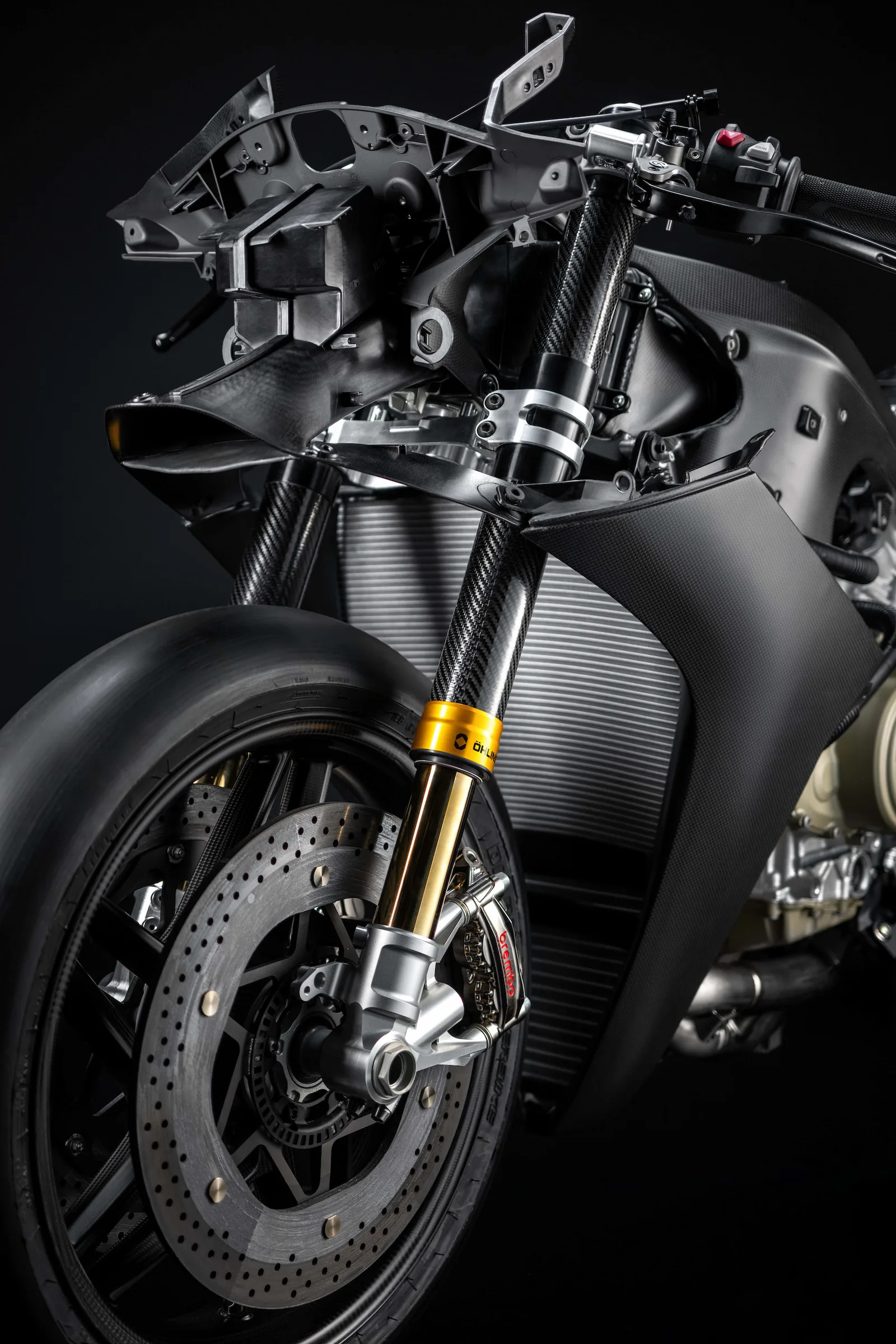
The front brakes use new Brembo Hyction 340 mm discs with a core of CSiC, a ceramic compound reinforced with carbon fiber. Ducati's case for them is heat: the discs keep working at very high temperatures, so braking stays consistent lap after lap without going to bigger, thicker metal discs.
Against steel discs, Ducati says each carbon-ceramic disc stops just as hard but weighs 450 grams less and has 40% lower moment of inertia. Less spinning mass at the front lets the bike turn in more easily. Compared with the standard 330 mm Panigale V4 discs, the weight is the same but inertia is lower still because the mass is placed more favorably, and the discs tolerate hard track use far better.
Brembo GP4-HY monoblock calipers, machined from solid aluminum with cooling fins and mixed 30 and 34 mm pistons, squeeze dedicated pads. An anti-drag design pulls the pads fully off the disc when you let go of the lever, so no residual drag unsettles the bike as you release the brake into a corner.
Suspension
Up front is the Öhlins NPX 25/30 Carbon, a pressurized fork whose sleeves are made from unidirectional carbon-fiber layers. Ducati says it weighs 8% less than the Panigale V4 R fork and 10% less than the standard Panigale V4 fork, which you should feel in quicker direction changes and clearer feedback from the front tire. The fork is a mechanical unit that keeps its cartridge under pressure, which reduces cavitation and gives steadier support under braking and on the way into a turn.
The rear shock is an Öhlins TTX36 GP LW with a lightweight special steel spring and valving derived from MotoGP. Ducati says it follows small surface imperfections better, and its hydraulic settings can be changed by hand without tools. The suspension linkages are titanium to save more weight.
Carbon fiber chassis
Frame, swingarm, subframes and wheels are all carbon fiber, made with techniques Ducati says come from MotoGP and Formula 1. The front frame is 17% lighter than the aluminum one on the Panigale V4, with stiffness tuned for grip at lean and a natural tendency to hold a tight line. The swingarm is built on a sacrificial mandrel as a single one-piece structure; it is 21% lighter than the aluminum part while matching its lateral and torsional stiffness, which matters for drive out of corners.
The smaller savings add up: compared with the Panigale V4 S Carbon, the five-spoke wheels shed almost 300 grams, the front subframe saves 200 grams and the rear monocoque 3 lb. Each carbon part goes through three aerospace-grade non-destructive tests (thermography, phased-array ultrasound and computed tomography), a process Ducati has applied to every Superleggera since the 1299.
Desmosedici Stradale R 1100 engine
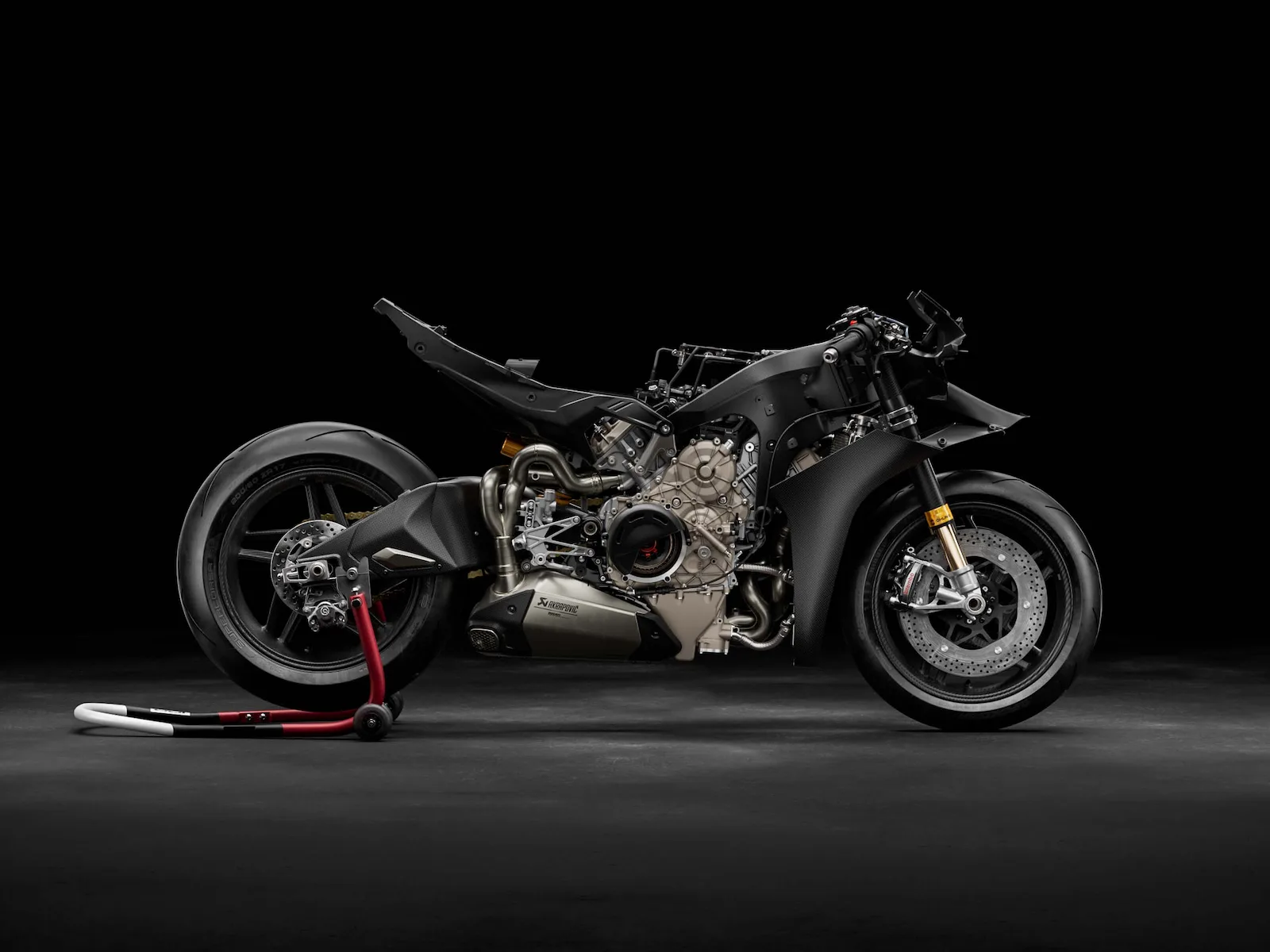
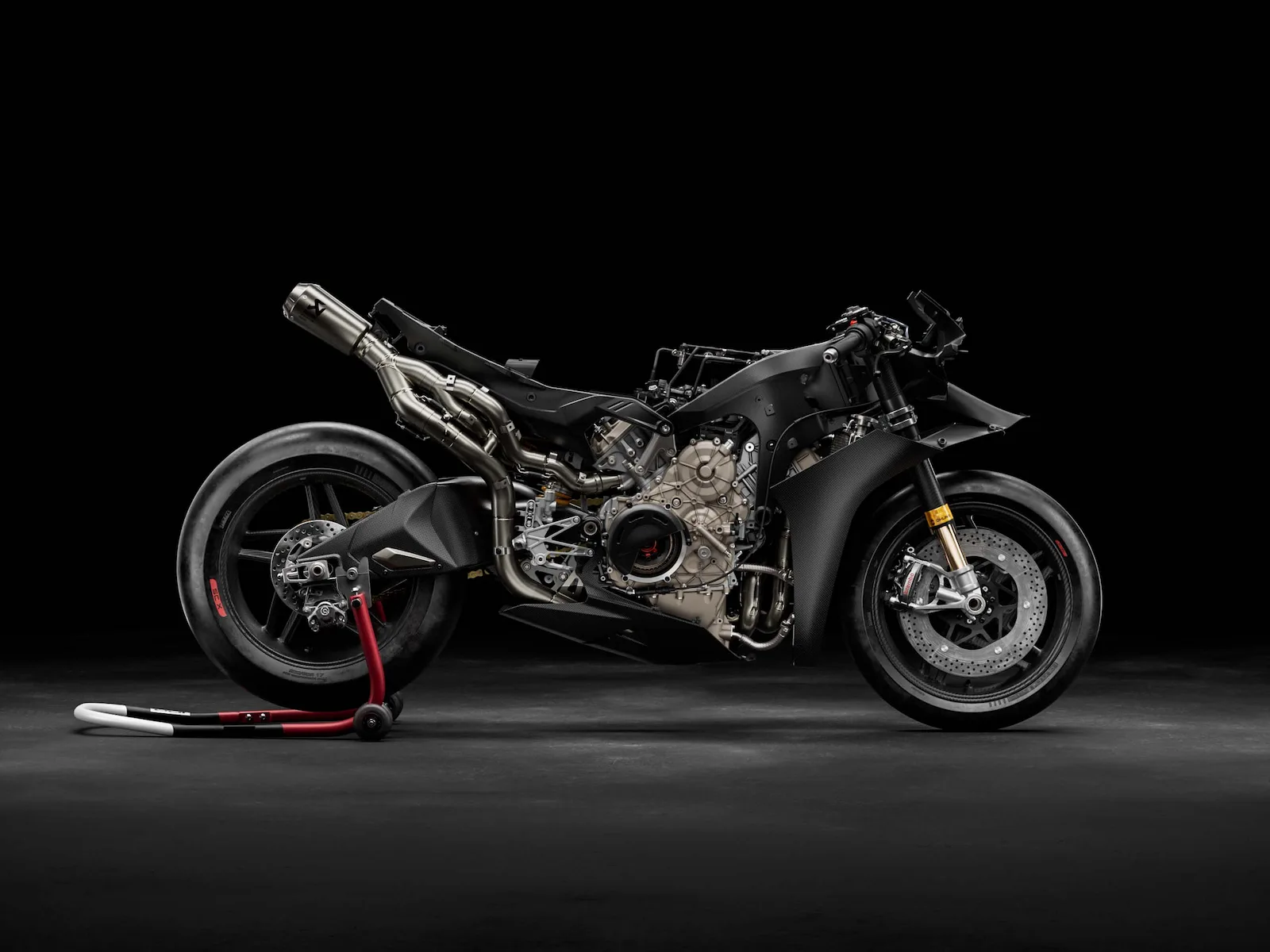
The engine is new for this bike. A longer stroke, up from 48.41 mm to 53.5 mm, takes displacement from 998 to 1,103 cc, which Ducati says brings more torque and stronger midrange drive without blunting how fast it revs. In road Euro 5+ trim it makes 228 hp; fit the Akrapovič track exhaust and run Ducati Corse Performance oil and output climbs to 247 hp, a level Ducati says no homologated motorcycle has reached before. The release does not give a torque figure.
It weighs 8 lb less than the 1,103-cc Panigale V4 engine with dry clutch, thanks to titanium parts, lighter fasteners and reworked internals with less rotating mass. Titanium connecting rods and titanium engine bolts are on the equipment list. The two-ring pistons use box-in-box construction and an oversized 18 mm piston pin to cope with the extra power.
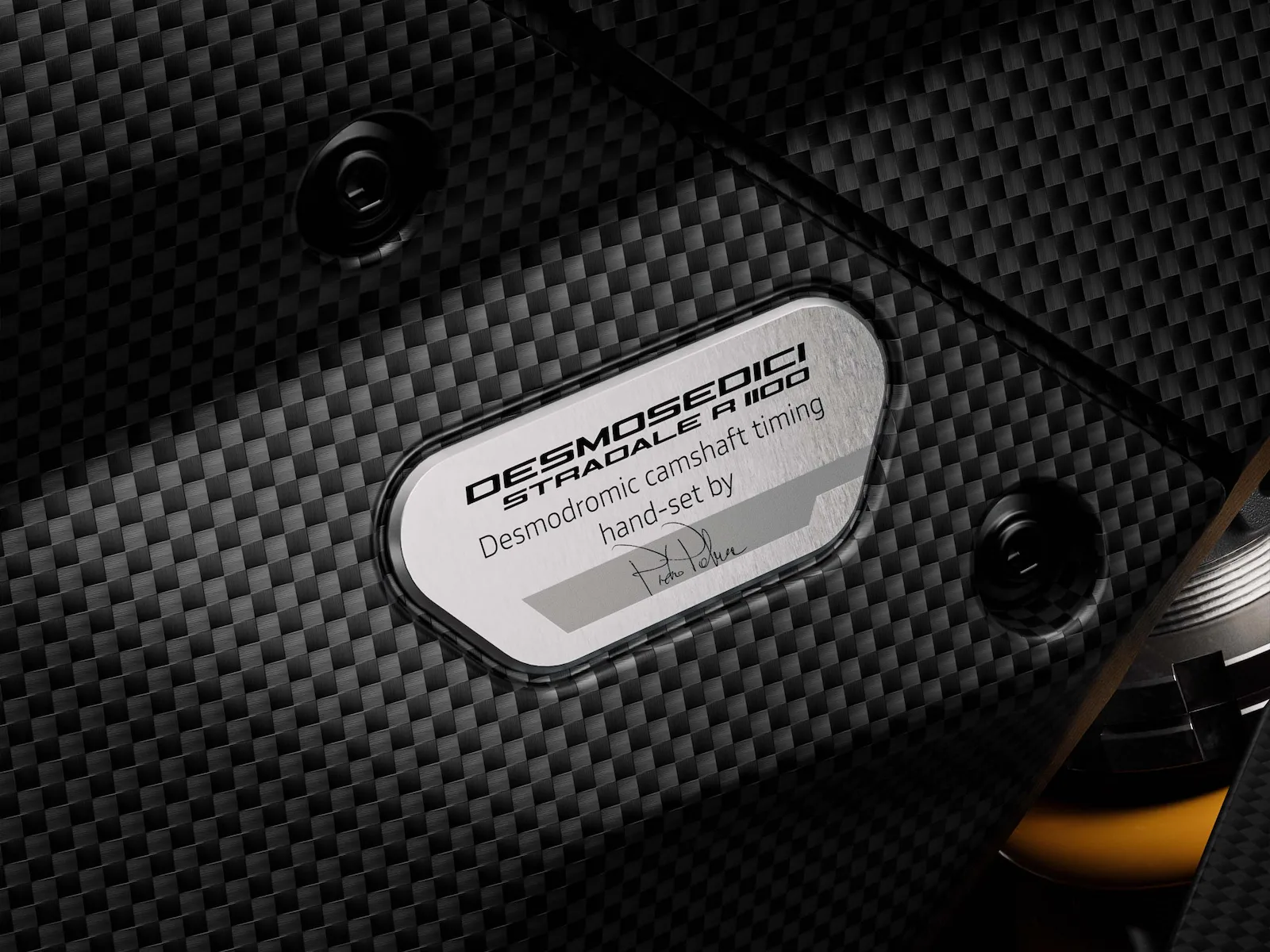
The heads keep the layout of the 998 cc Desmosedici Stradale R, using titanium intake valves of 34 mm and steel exhaust valves of 27.5 mm, and all sixteen valves use titanium collets. The desmodromic valve timing is set by hand, and a plate signed by the technician who checked it certifies the work.
The crankshaft swaps its steel counterweights for tungsten inserts. Because tungsten is far denser, smaller inserts placed at the outer edge do the same balancing job, so the engine revs up faster and responds sooner to the throttle, with less load on the bearings.
On the intake side, oval 56 mm throttle bodies replace the 52 mm units of the Desmosedici Stradale, the fixed trumpets are 20 mm long on the left and 10 mm on the right, and the upper injectors spray closer to the port for better atomization. Exhaust headers are titanium with a 41.7 mm diameter, ending in a road-approved Akrapovič silencer.
Gearbox, clutch and final drive
The Ducati Racing Gearbox puts neutral below first gear rather than between first and second. With the Ducati Neutral Lock (DNL) system, you cannot find neutral by mistake while braking hard into a first-gear corner, when losing engine braking would hurt most. With no neutral between first and second, that shift is quicker and more consistent too. An STM Revo clutch is listed as standard.
Final drive uses a DID ERV7 chain, the type run by factory Superbike teams, on an Ergal sprocket; together they save 1.5 lb against the Panigale V4 S parts.
Aerodynamics and bodywork
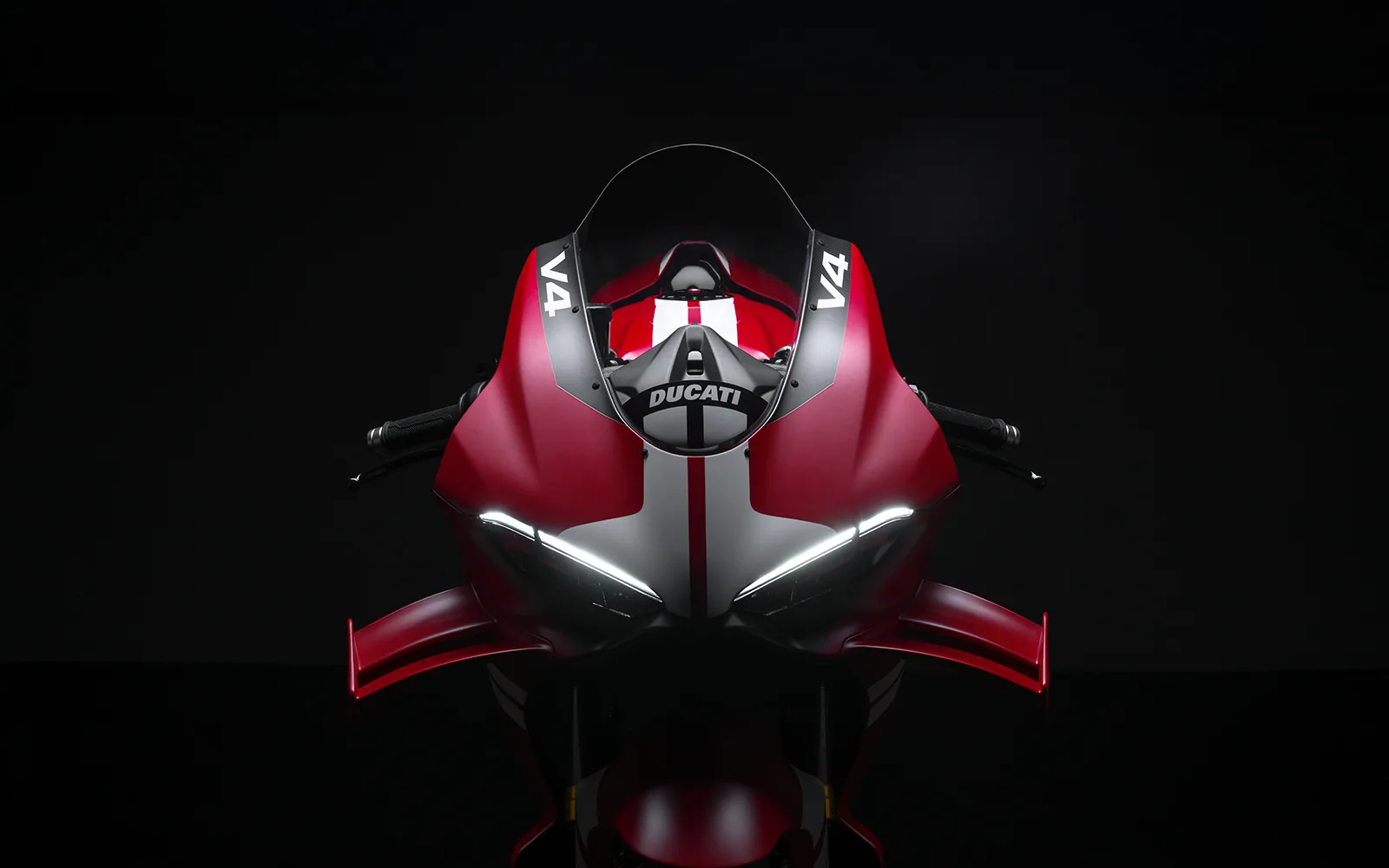
The wings and Corner Sidepods come straight from the Panigale V4 R Superbike. The sidepods, first used by Ducati in MotoGP in 2021, create a ground effect at mid-corner that adds tire grip when the bike is leaned over, which means more corner speed.
The fairing is all carbon fiber, partly left unpainted to show the weave. Many smaller parts are carbon too, including the fenders, tank cover, sprocket cover, heel guards, seat base, intake duct and license plate holder. The radiator cap, footrest plates, accessory fuel cap and both triple clamps are billet aluminum, with each bike's number (out of 500) lasered onto the top clamp. The same number appears in a dashboard animation and on the titanium insert of the key.
Rosso Centenario GP26 livery
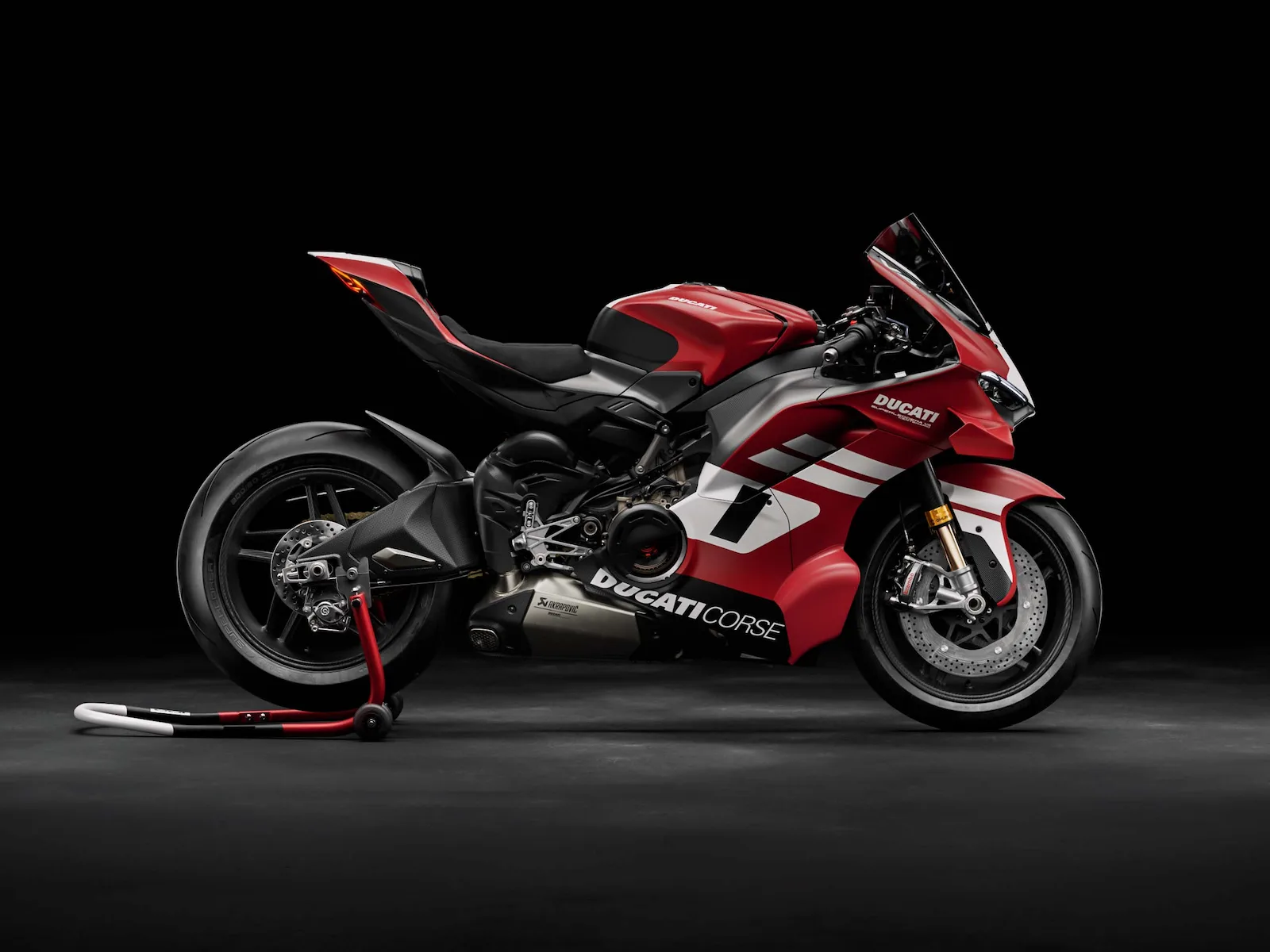
The GP26 livery pairs Ducati's white stripes with a new matte dark red, Rosso Centenario, a nod to the red of the 1949 Ducati 60, the company's first complete motorcycle, and the 1955 Gran Sport 'Marianna', its first racing design, by engineer Fabio Taglioni. Ducati says this livery inspired the 2026 colors of its official MotoGP and SBK bikes, including the Lenovo team's Desmosedici.
Electronics
The electronics start from the Panigale V4 R package, recalibrated and extended with new DVO strategies, and run off a 6D IMU. Traction control (DTC) DVO, wheelie control (DWC) DVO, Ducati Slide Control and Ducati Power Launch (DPL) DVO use new algorithms for finer control. Ducati Quick Shift 2.0 is standard, and cornering ABS has four levels.
Alongside RaceBrake Control and Road eCBS, the ABS now works with Engine Brake Control DVO and its new Dynamic Engine Brake (DEB) function. DEB uses the rear brake to help manage engine braking, based on how much load is on the rear wheel. It also keeps some rear brake on into the corner after you have released the front, the way professional riders do by foot. That lets a less experienced rider concentrate on the front lever on entry while the bike helps tighten the line.
What comes in the crate
Each bike is delivered in a custom wooden crate with a boxed certificate of authenticity, a bike cover, a mat and front and rear paddock stands. The track kit includes the Akrapovič racing exhaust with DAVC Race Pro software and its own calibration, a dedicated lower fairing and an open clutch cover, plus carbon swingarm and alternator cover protectors.
There is also a kit to remove the headlights, side stand, license plate holder and turn signals for track use, a machined aluminum racing fuel cap, a brake lever guard, a battery charger and a neoprene racing seat. Ducati's equipment list marks the racing exhaust, lower fairing, open clutch cover, removal kit and racing fuel cap as not approved for road use.
Owners alone can also order a limited-edition helmet, leather jacket and suit in colors matching the GP26 livery. North American deliveries start in Q1 2027 and include the limited-edition riding jacket and helmet.